Cervical Myelopathy
Impaired spinal cord function associated with compression in the neck.
General educational information is not a diagnosis or treatment recommendation for an individual.
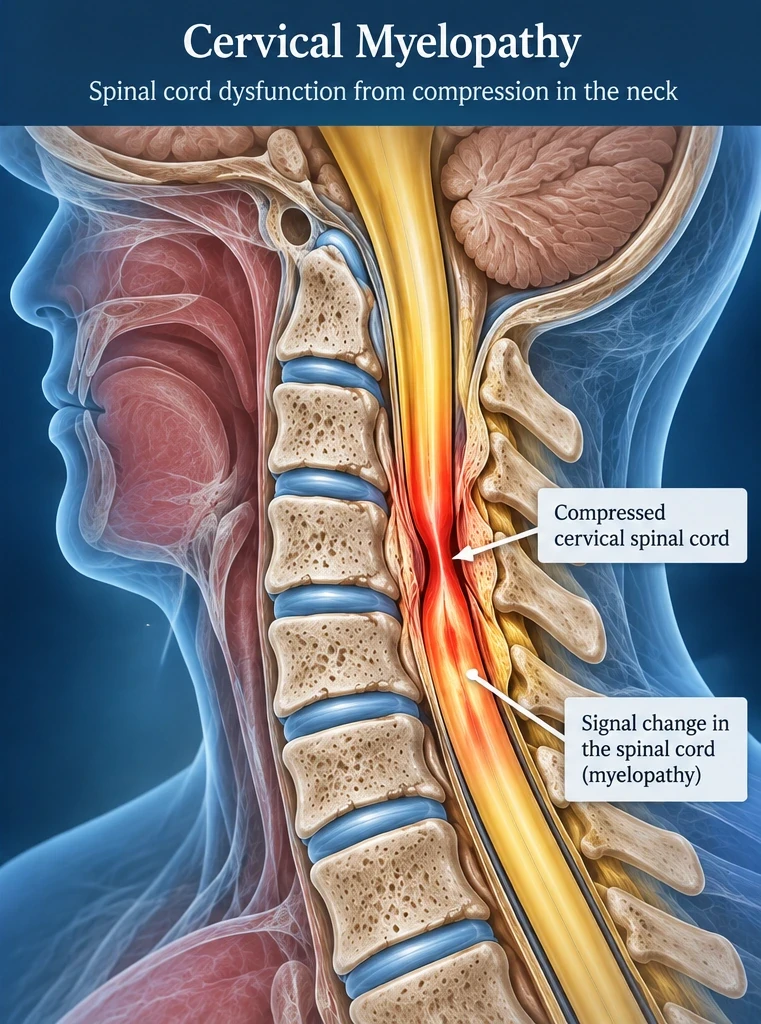
Overview
Cervical myelopathy describes impaired function of the spinal cord in the neck. Degenerative cervical myelopathy occurs when age-related spine changes compress the cord. Other causes of cord compression also require evaluation.
Myelopathy is different from a single irritated nerve root, which may cause arm pain or numbness. Cord involvement can affect hand coordination, balance, and walking, even when neck pain is mild or absent.
Symptoms
Possible symptoms include difficulty buttoning clothing or writing, dropping objects, hand numbness or weakness, an unsteady gait, and changes in coordination. Some people have neck pain or stiffness.
Symptoms can develop gradually or worsen more quickly. New hand coordination or balance changes should not simply be assumed to be normal aging. Other neurological conditions can cause similar problems.
Causes and Risk Factors
Disc degeneration, disc herniation, bone spurs, and thickened supporting tissues can narrow the cervical canal. A naturally narrow canal can increase susceptibility to compression. Injury and other disorders can also affect the cord.
Evaluation and Diagnosis
A clinician reviews hand function, balance, walking, symptom progression, and relevant health history, then examines strength, sensation, reflexes, and gait. MRI is commonly used to assess cord compression. X-rays or CT may clarify alignment or bone changes.
Both neurological examination and imaging matter. Canal narrowing without cord-related symptoms is not identical to a diagnosis of clinical myelopathy.
Treatment Approaches
Management depends on severity, progression, anatomy, and overall health. Selected mild cases may be considered for careful clinical monitoring or supervised nonsurgical management. Symptom-relief measures do not remove pressure on the spinal cord.
Surgery may be considered to relieve compression and reduce the risk of further neurological deterioration. The approach depends on the affected levels and alignment. Existing neurological impairment may not fully recover, and no outcome can be guaranteed.
When Surgical Evaluation May Be Appropriate
Suspected cervical myelopathy warrants timely specialist evaluation, particularly when hand function, gait, or strength is worsening. A clinician can determine how promptly assessment or treatment is needed.
Surgery is often discussed for clinically significant or progressive myelopathy. Monitoring is not the same as ignoring progression; ask which changes require reassessment and what follow-up is appropriate.
Urgent Warning Signs
Seek emergency assessment for sudden or rapidly worsening weakness, inability to walk, or new loss of bladder or bowel control, particularly with other neurological changes. Do not wait for a routine appointment. Call 911 if emergency transport is needed.
Gradually worsening hand coordination, balance, or strength also deserves prompt clinical contact. These examples are not exhaustive.
Questions to Discuss With Your Clinician
Which findings explain my symptoms, and are other causes possible?
What nonsurgical and surgical options are reasonable for me? What are their risks and limitations?
What changes should prompt urgent reassessment, and what follow-up is appropriate?
If surgery is discussed, what is its goal, what may not improve, and what happens if I defer it?
Frequently Asked Questions
Is myelopathy the same as neck pain?
No. Myelopathy concerns spinal cord function; neck pain alone does not establish it.
Can an injection remove pressure on the cord?
No. Pain relief does not correct the underlying compression. Discuss the safety and suitability of any treatment with the clinician evaluating the cord.
Will surgery reverse every symptom?
Not necessarily. Goals and potential improvement vary, and established deficits may persist. Ask about the goals and limitations in your situation.
References and Further Reading
Discuss Your Questions With Our Team
A consultation can help you understand findings and appropriate options. Medical emergencies need emergency assessment, not a routine appointment.